

Bengaluru's real estate market in 2026 is no longer just growing — it is fundamentally transforming. From metro-driven micro-markets to luxury smart homes and a surge in NRI investment, the city's property landscape is entering a new chapter. Here's what every buyer, investor, and homeowner needs to know right now.
Table of Contents
- Introduction
- The Current State of Bengaluru Real Estate in 2026
- Major Factors Driving Market Changes
- Top Emerging Investment Locations in Bangalore
- Infrastructure & Metro: The Value-Creation Engine
- Luxury vs Affordable Housing Trends in 2026
- Why Property Legal Verification Is Non-Negotiable Before Buying
- Future Predictions for Bangalore Real Estate (2026–2030)
- Key Takeaways
- Frequently Asked Questions (FAQs)
- Conclusion
The Current State of Bengaluru Real Estate in 2026
If you have been tracking the Bengaluru real estate market in 2026, one thing is abundantly clear: this is a market that has matured without losing momentum. Despite global economic headwinds, Bangalore's property sector has demonstrated remarkable resilience, backed by a deep technology ecosystem, world-class educational institutions, and one of India's youngest urban demographics.
Bangalore property prices have appreciated an average of 12–18% year-on-year in high-demand corridors. Residential absorption has crossed historic highs, with over 58,000 units registered in the first two quarters of 2026 alone. Commercial Grade-A office leasing has simultaneously broken records, reinforcing residential demand in proximity zones. In short, the Bangalore real estate investment story is not just intact — it is accelerating.
Key Stats:
- 18% — Avg. Price Appreciation (Prime Corridors, YoY)
- 58K+ — Residential Units Registered (H1 2026)
- 4.8% — Avg. Rental Yield in Bangalore (2026)
The Bangalore property market trends reveal a shift in buyer preferences. Post-pandemic, demand for larger homes with dedicated workspaces has permanently reconfigured what people want. Developers have responded — and 2026 supply is decidedly tilted towards 2BHK and 3BHK configurations with smart-home integrations and green-building certifications.
Major Factors Driving Market Changes
- The IT Economy Remains the Anchor Bengaluru hosts over 35% of India's IT workforce, and global tech MNCs continue to expand their footprints here. The ripple effect on residential demand is direct and sustained. Areas adjacent to major tech parks — Whitefield, Electronic City, and the Outer Ring Road (ORR) corridor — continue to see relentless demand for both ownership and rental housing.
- Namma Metro Expansion The ongoing Namma Metro Phase 2 and Phase 2A expansions are arguably the single largest driver of property value shifts in 2026. New stations connecting Hebbal, Devanahalli, and Yelahanka to the city core have catapulted these micro-markets from peripheral to premium. The metro expansion's impact on property prices is visible in 10–22% price jumps in 500-metre catchment zones around upcoming stations.
- Peripheral Ring Road (PRR) Progress The PRR's partial operationalization has unlocked new development corridors, particularly in North Bangalore real estate and the Devanahalli–Yelahanka belt. Land parcels here, once considered speculative, are now attracting marquee developers and institutional investors.
- Return of NRI Investment Favourable currency conversion rates and India's structural growth story have brought NRIs back into the property investment in Bangalore market in significant numbers. Technology-enabled property tours, digital KYC, and simplified FEMA-compliant transaction processes have further lowered the barrier to remote investment.
- Sustainability & Smart Living as Differentiators Smart homes in Bangalore and sustainable housing in Bangalore are no longer niche offerings — they are becoming baseline expectations. IGBC-certified projects and properties with solar-ready infrastructure, EV charging provisions, and rainwater harvesting command a 7–12% premium over conventional builds, and the premium is growing.
Top Emerging Investment Locations in Bangalore
- Whitefield — Mature IT corridor. Highest transactional volume city-wide. Strong rental yield averaging 4.5–5.2%. [High Demand]
- Sarjapur Road — Emerging family favourite. Proximity to RGA Tech Park & top schools. Rapid appreciation corridor. [Appreciation Zone]
- Devanahalli — Airport proximity, BIAL Aerospace SEZ, and aerospace township driving North Bangalore supply. [Long-term Play]
- Hebbal — Luxury enclave close to Manyata Tech Park. Premium apartments and villa communities. NRI preferred. [Luxury]
- Electronic City — Affordable entry point with strong rental demand from IT workforce. Steady and reliable returns. [Value Buys]
- Yelahanka — Well-planned residential zone. Metro connectivity boost making it one of the fastest-growing areas of 2026. [Infrastructure-led]
Acreok Insight: The Sarjapur Road investment story is particularly compelling for 2026–2029. With limited land parcels, a booming tech corridor, and new ring road access, early buyers stand to benefit from above-average capital appreciation over the next 3 years.
Infrastructure & Metro: The Value-Creation Engine
|
Infrastructure Project |
Impact Areas |
Est. Price Uplift |
|
Namma Metro Phase 2 (RV Road–Bommasandra) |
Electronic City, JP Nagar |
10–15% |
|
Metro Phase 2A (Silk Board–KR Puram) |
ORR Corridor, Whitefield |
12–20% |
|
Peripheral Ring Road (Hebbal–Sarjapur) |
North & East Bangalore |
15–22% |
|
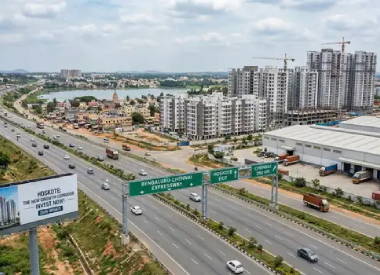
Bangalore–Chennai Expressway |
Devanahalli, Hoskote |
18–28% |
|
BIAL Aerospace SEZ (Devanahalli) |
Yelahanka, Devanahalli |
20–30% |
The metro expansion impact on property prices is particularly visible in the ORR belt. Areas that were 25–30 minutes from central Bangalore by car are now accessible within 18 minutes via metro, fundamentally altering commute calculus and making previously affordable zones attractive to a wider buyer pool.
Luxury vs Affordable Housing Trends in 2026
Bangalore Luxury Apartments: A Booming Premium Segment Bangalore luxury apartments in the ₹1.5 crore to ₹10 crore+ range have seen the highest volume growth in 2026 — a 34% year-on-year increase in registrations. This is driven by HNI buyers, returning NRIs, and senior tech professionals seeking large-format homes with concierge-grade amenities. Hebbal, Indiranagar, and premium stretches of Whitefield are epicentres of this segment.
Developers are responding with ultra-luxury offerings: sky lounges, private elevator lobbies, branded wellness centres, and fully integrated smart home systems. Smart homes in Bangalore now feature AI-driven climate control, automated security, and energy management systems as standard in the ₹2 crore+ bracket.
Affordable & Mid-Segment: The Volume Engine The backbone of the market remains the ₹40 lakh–₹1 crore segment — particularly in Electronic City, Sarjapur Road, and newer townships in North Bangalore. First-time buyers, young IT professionals, and families upgrading from 1BHK to 2BHK are driving this segment. Government incentives under PMAY and lower home loan rates have kept this segment buoyant.
Rental Yield Snapshot: Rental yield in Bangalore ranges from 3.5% in premium neighbourhoods to 5.5% in tech corridors like Electronic City and Whitefield. This compares favourably with Mumbai (2.5–3.5%) and Delhi NCR (2.8–3.8%), making Bangalore one of India's best cities for buy-to-let strategies.
Why Property Legal Verification Is Non-Negotiable Before Buying
The single costliest mistake a property buyer can make in Bangalore is skipping or shortcutting legal due diligence. Karnataka's property laws involve multiple layers — BDA/GBA approvals, Khata registration, EC (Encumbrance Certificate) verification, RERA registration, and revenue records — and a deficiency in any one of these can render a transaction legally vulnerable.
Critical Documents to Verify Before Purchase:
- Title Deed & Chain of Title: Establishes legal ownership. Gaps in the chain can create irresolvable disputes.
- Encumbrance Certificate (EC): Confirms the property is free of mortgages, liabilities, or legal claims for a specified period.
- Khata Certificate & Extract: Mandatory for GBA tax assessment, utility connections, and building plan approvals. Essential before sale or purchase.
- RERA Registration: Mandatory for any under-construction project. Verify at Karnataka RERA's official portal before booking.
- Occupancy Certificate (OC) & Completion Certificate (CC): Critical for ready-to-move properties. Absence may indicate deviations from sanctioned plans.
- Revenue Records (RTC/Pahani): Critical for land and plot purchases to confirm land category, ownership, and any encumbrances.
Buyer Alert: Many resale properties in Bangalore still lack updated Khata records — especially post-GBA ward mergers. Always ensure Khata transfer services are completed and a fresh Khata is issued in the buyer's name before registration.
Property legal verification in Bangalore is not merely a checkbox — it is the foundation of a secure, dispute-free investment.
Future Predictions for Bangalore Real Estate (2026–2030)
- North Bangalore will emerge as Bangalore's second premium zone — Devanahalli and the BIAL corridor could replicate Whitefield's growth arc from 2015–2022 over the next 5 years.
- Sustainable housing in Bangalore will shift from a premium feature to a regulatory baseline, as GBA and BDA tighten green building norms.
- Micro-market polarisation will intensify — areas with metro access will outperform non-metro corridors by an increasing margin.
- Fractional ownership and REITs will democratize commercial real estate access for retail investors.
- PropTech adoption will reshape discovery, due diligence, and registration — with digital encumbrance searches, online sub-registrar scheduling, and AI-driven property valuations becoming standard.
Key Takeaways
- The Bengaluru real estate market in 2026 is experiencing 12–18% price appreciation in prime corridors with no signs of correction.
- Metro connectivity is the #1 infrastructure factor to evaluate when assessing any property's long-term value potential.
- North Bangalore (Devanahalli, Yelahanka) is 2026's most compelling long-term investment geography.
- Whitefield and Sarjapur Road remain the city's highest-volume residential markets with strong rental yield in Bangalore.
- Bangalore luxury apartments have seen a 34% YoY increase in registrations, led by NRI and HNI buyers.
- Property legal verification — including Khata transfer — is essential before any purchase and protects buyers from costly future disputes.
- Sustainable housing and smart homes are now priced at a premium and appreciating faster than conventional builds.
- Acreok offers end-to-end services: consultation, legal verification, Khata transfer, and property registration — all under one roof.
Frequently Asked Questions (FAQs)
Is Bangalore a good place to invest in real estate in 2026? Yes — Bangalore remains one of India's most compelling real estate investment destinations in 2026. Backed by a thriving IT economy, robust infrastructure development, consistent population inflow, and a strong rental market, the city offers both capital appreciation (12–18% YoY in prime corridors) and reliable rental yield (4–5.5%).
Which area in Bangalore has the highest property appreciation in 2026? Devanahalli and the broader North Bangalore corridor have recorded the highest year-on-year appreciation in 2026 — driven by BIAL airport proximity, the upcoming Aerospace SEZ, and PRR connectivity. Within the city, Whitefield and Sarjapur Road continue to show strong appreciation of 14–18% annually.
How does metro expansion affect property prices in Bangalore? Properties within 500 metres to 1 kilometre of an operational or upcoming metro station typically appreciate 10–22% more than comparable properties without metro access.
Why is legal verification important before buying property in Bangalore? Karnataka's land records have historical complexities — land conversion status, BDA/GBA approval gaps, outdated Khata records, and undisclosed encumbrances can render a property legally vulnerable post-purchase.
What is a Khata and why is Khata transfer important in Bangalore? A Khata is a GBA document that records a property's details for tax assessment purposes. Without a valid Khata in the buyer's name, you cannot obtain building plan approvals, utility connections, or trade licences. It is also essential for a future resale.
What is the average rental yield in Bangalore in 2026? The average rental yield in Bangalore in 2026 ranges from 3.5% to 5.5% depending on location and property type. Electronic City and Whitefield offer the highest yields in the 4.5–5.5% range.
Can NRIs invest in Bangalore real estate in 2026? Yes. NRIs are legally permitted to invest in residential and commercial property in Bangalore under FEMA guidelines, with certain exceptions (agricultural land, plantation property, and farmhouses are restricted).
Which is better for investment in 2026 — Whitefield or Sarjapur Road? Whitefield is a mature market ideal for immediate rental income and lower vacancy risk. Sarjapur Road is a higher-growth appreciation play with lower entry prices. For capital appreciation over 3–5 years, Sarjapur Road holds a slight edge. For stable rental yield today, Whitefield is the safer bet.
Conclusion
The Bengaluru real estate market in 2026 is a story of confidence, growth, and intelligent demand. The city's property sector is no longer purely speculative — it is underpinned by a deep talent economy, transformative infrastructure, and a buyer base that is more informed and selective than ever before. Whether you are eyeing a luxury apartment in Hebbal, a mid-segment home on Sarjapur Road, or a long-term land investment near Devanahalli, the opportunity is real — and it is growing.
The Bangalore property market is changing. Make sure you are positioned to benefit from it.





Leave a Reply
Your email address will not be published. Required fields are marked*